Is GTMSkills.com a Legit Skill Goldmine, or a Hoax?
Short answer: it’s legit. It’s not a hoax, not a lead-gen trick disguised as a library. But “free” needs an asterisk, and the asterisk matters if you’re planning to actually run these skills, not just read them.
Here’s what we found after going through the site, the GitHub repo, and a handful of the actual skill files.
What GTMSkills.com actually is
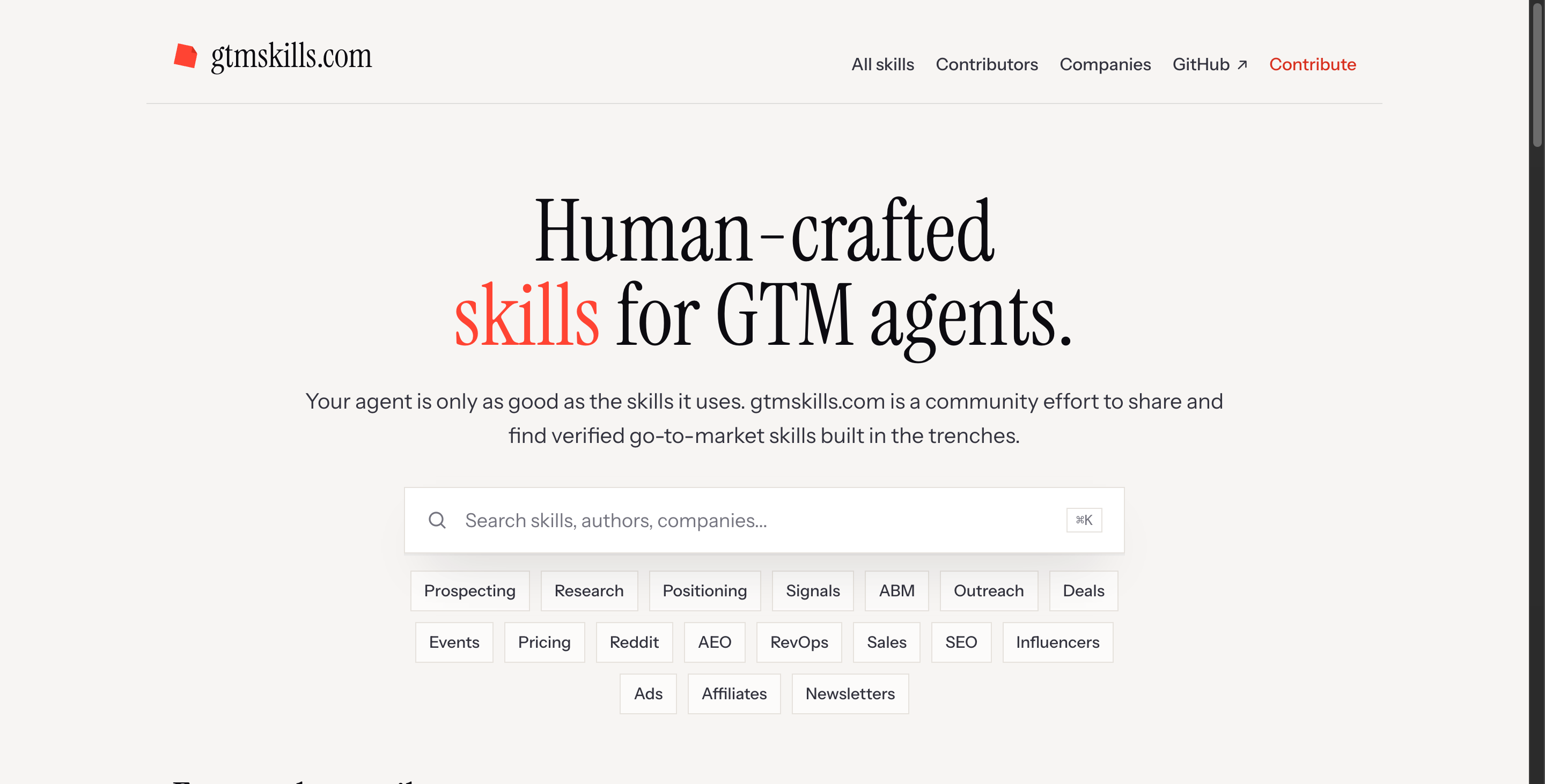
It’s a public library of “skills” — structured instruction files (SKILL.md) written for AI agents doing go-to-market work: prospecting, outreach, ABM, SEO, RevOps, and more. Think of a skill as a detailed playbook an agent reads before doing a task, not a piece of software.
The library is maintained by Swan, an AI GTM agent company, and authored by a wide community of practitioners — agency founders, RevOps leads, a few well-known GTM names (Manny Medina, Sam Jacobs, Maja Voje among them).
A few numbers that back up “this is real”:
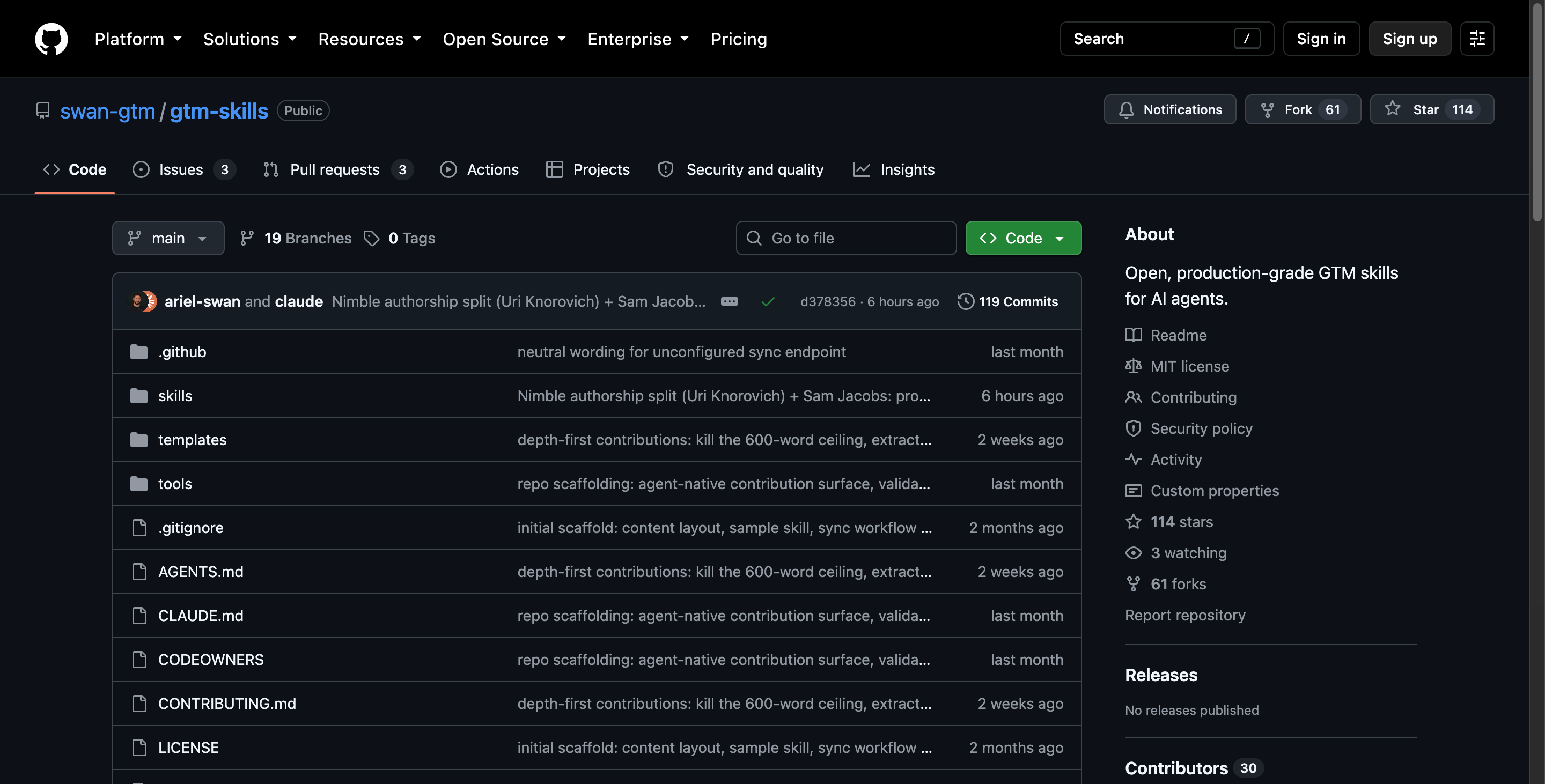
- 114 GitHub stars, 61 forks, 119 commits on the source repo.
- 61 different companies contributing skills, not just Swan’s own team.
- Every skill is MIT-licensed — free to read, copy, and modify, no signup wall to view the prompt.
- Skills install with a real CLI:
npx skills add swan-gtm/gtm-skills --skill <name>, targeting Claude Code, Cursor, Codex, or “70+ others.”
That’s not vaporware. It’s an active open-source project with real contributors and real commit history.
What’s genuinely good about it
The best skills we read are just solid, tool-agnostic playbooks. Take “Outreach messaging” by Maja Voje:
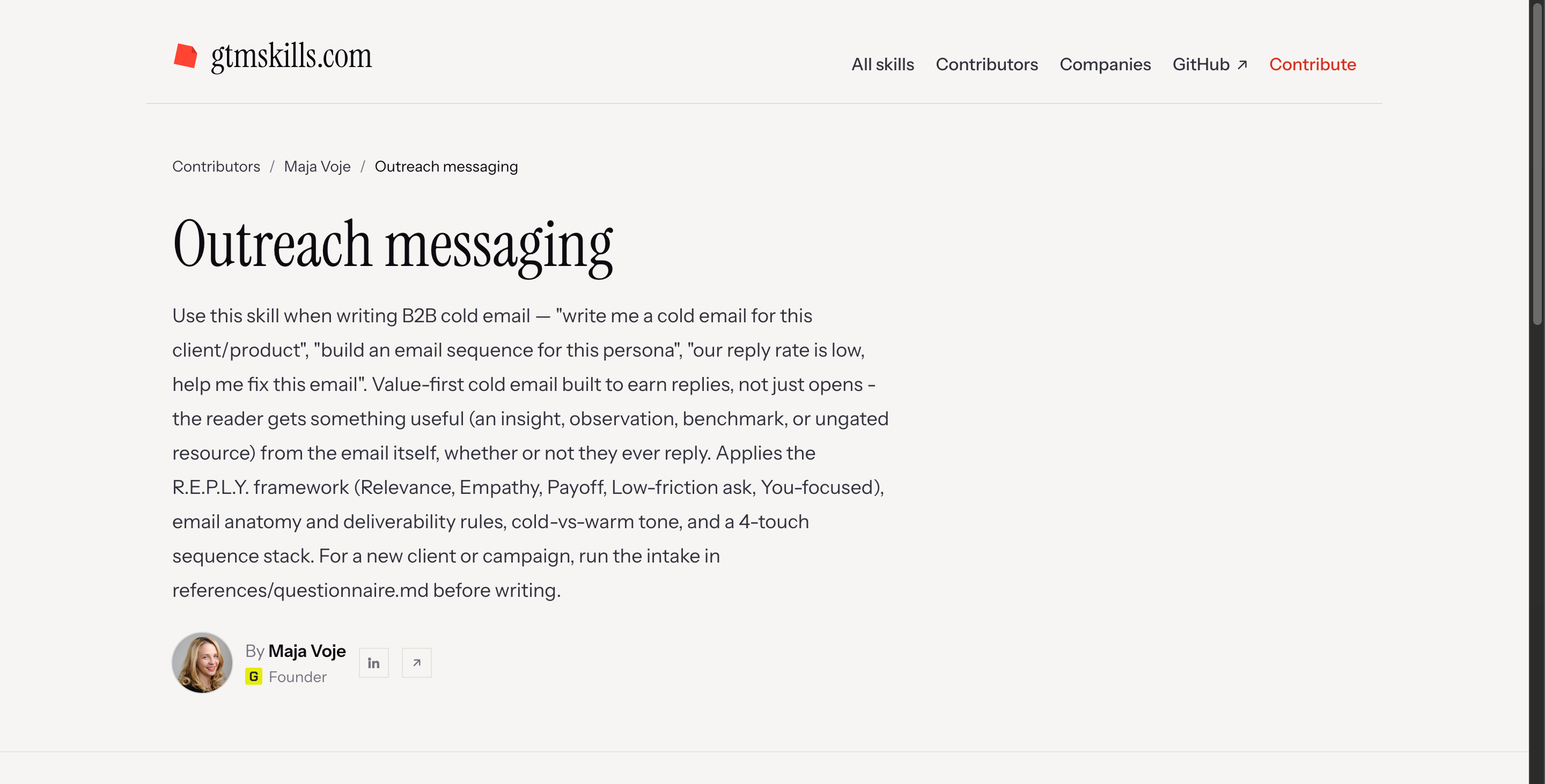
No vendor names, no proprietary tool calls — just a genuinely useful cold-email framework (they call it R.E.P.L.Y.: Relevance, Empathy, Payoff, Low-friction ask, You-focused), a sequencing table, and a self-edit checklist. Drop this into any agent, or just read it yourself as a human copywriter, and it works. This is the kind of skill the project’s own contributing guide asks for: skills should “speak in GTM verbs… never vendor tool names, so they work whatever your stack is.”
If every skill in the library looked like this one, the “goldmine” half of the title would win outright.
The catch: some skills are quietly Swan-shaped
Not every skill follows that rule. Take “Build list”, one of the featured prospecting skills (934 installs — the most popular one on the site):
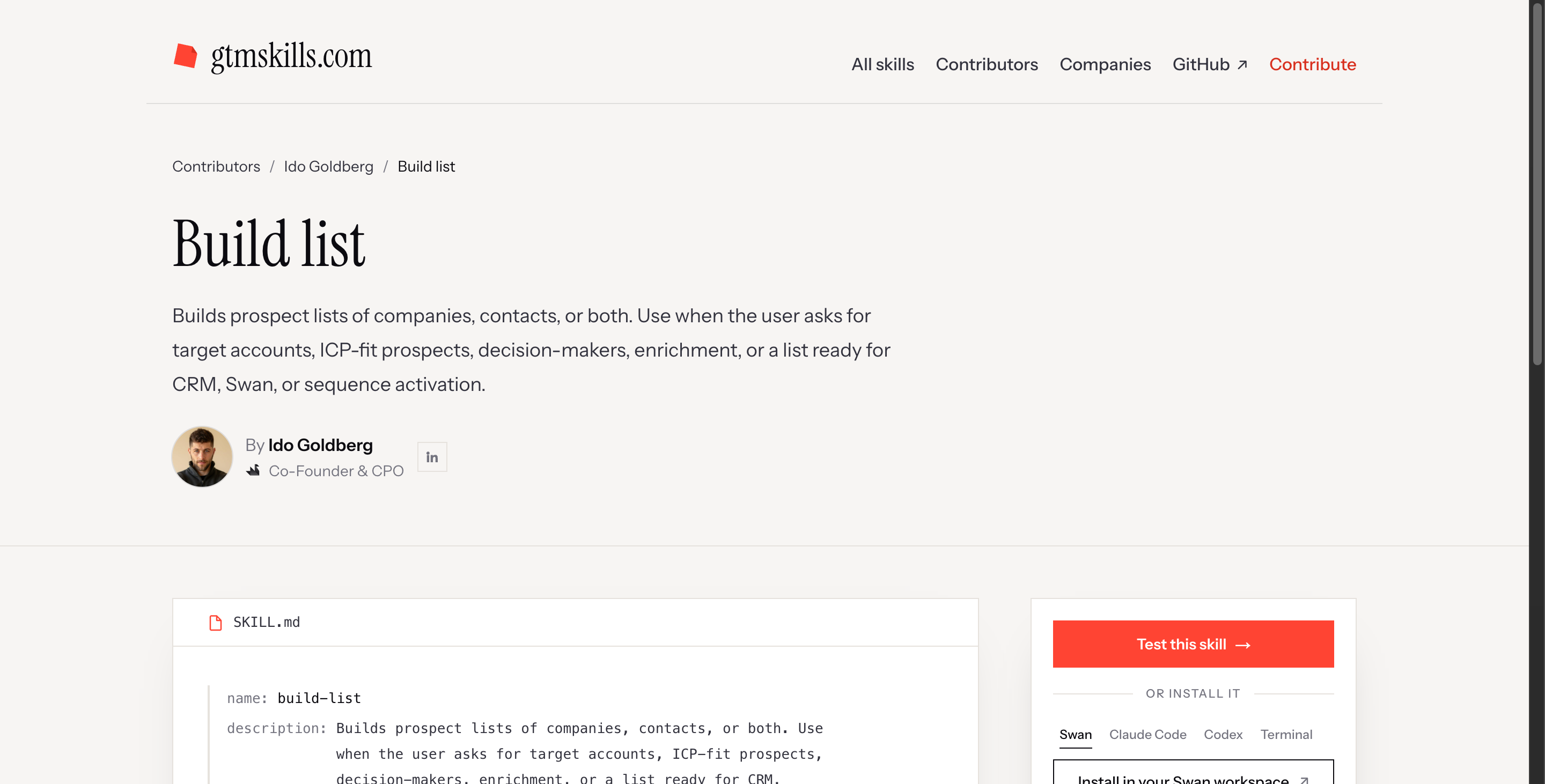
The instructions are genuinely good — a “column ladder” method for building prospect lists cheaply before spending on paid enrichment is smart methodology. But the actual steps call specific tools by name: swan-fetch-businesses, swan-autocomplete-business-filter, swan-search-employees, swan-enrich-email, swan-execute-code. Those aren’t generic actions — they’re Swan’s own agent tools. Outside a Swan workspace, an agent can read the thinking, but can’t run the steps as written; you’d have to translate every swan-* call into whatever your own stack uses (Apollo, Clay, Apify, a CRM).
| Tool-agnostic skill (e.g. Outreach messaging) | Swan-native skill (e.g. Build list) | |
|---|---|---|
| Reads useful stand-alone | Yes | Yes, as strategy |
| Runs as-is outside Swan | Yes | No — needs a stack swap for every tool call |
| Needs a paid platform to execute fully | No | Effectively yes (Swan starts at $240/mo for 4,000 credits) |
| Author | Independent contributor | Swan’s own Co-Founder & CPO |
That’s the pattern worth knowing before you get excited: skills authored by people outside Swan tend to read like portable playbooks. Several of the flagship, Swan-authored skills read like Swan’s own product documentation wearing a “free and open” badge.
The community is real, but concentrated
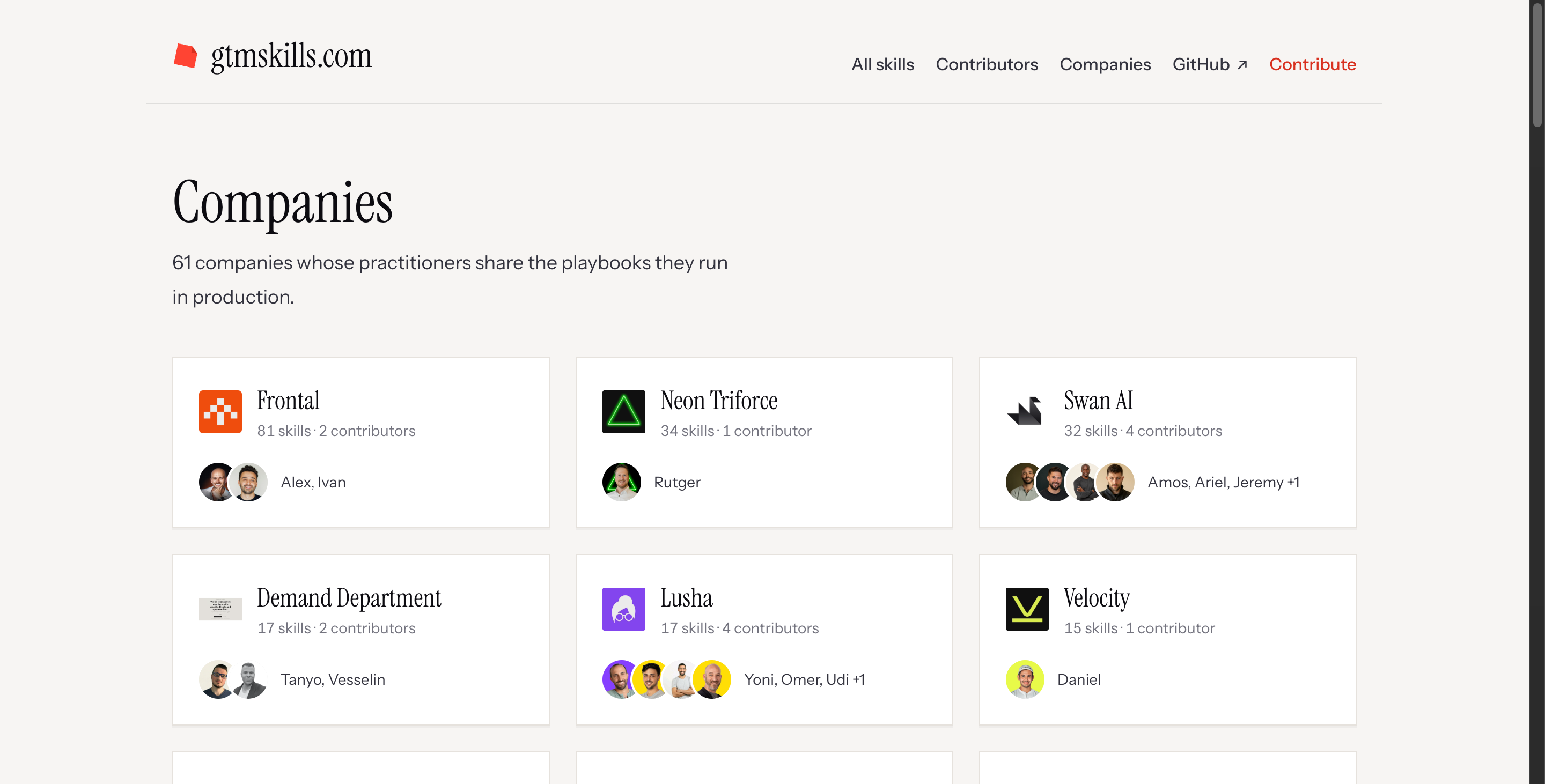
61 companies contribute, which is a genuinely broad base — agencies like Frontal (81 skills) and Neon Triforce (34 skills) contribute more volume than Swan AI itself (32 skills). That’s a point in favor of “real community,” not just a Swan marketing funnel with extra steps.
Still, worth noting: the top contributor by skill count, several featured contributors, and the platform doing the curating are all the same company. The GitHub README explicitly separates a skill’s portable SKILL.md from an optional swan.md “Swan-specific execution layer” — a good design decision that some contributors clearly follow and some don’t yet.
Verdict
Not a hoax. It’s a real, MIT-licensed, actively maintained library with a genuinely broad contributor base and some excellent, tool-agnostic playbooks worth reading even if you never touch an AI agent.
Not a pure goldmine either. Treat every skill as a prompt to adapt, not a script to run unmodified. Before you install one, skim the actual SKILL.md on GitHub and check whether it names generic actions (“check the CRM,” “load the ICP”) or specific swan-* tool calls. The first kind works anywhere. The second kind is a Swan pitch with a permissive license on it.
If you’re prospecting and don’t want to commit to a $240/mo agent platform just to run one skill, plainer tools still do the job. GrowthToolz’s LinkedIn Bulk Search, for instance, pulls profile data straight into a Google Sheet with no credit metering and no LinkedIn login shared with a third party — it won’t run an autonomous multi-step agent workflow like Swan does, but for the “get me a list” step specifically, it’s free and doesn’t require adopting a new platform.